
Kacwin: Architectural History and Hiking Trails
Accommodation in Kacwin
Kacwin can be explored through its architectural history and hiking trails, with stated walking times. The open-air museum showcases traditional Sypańce, while the churches reflect different historical connections. For planning your route, a circular walk through the village and the hiking trail to the Nad Łapszanką Pass are two specific options.
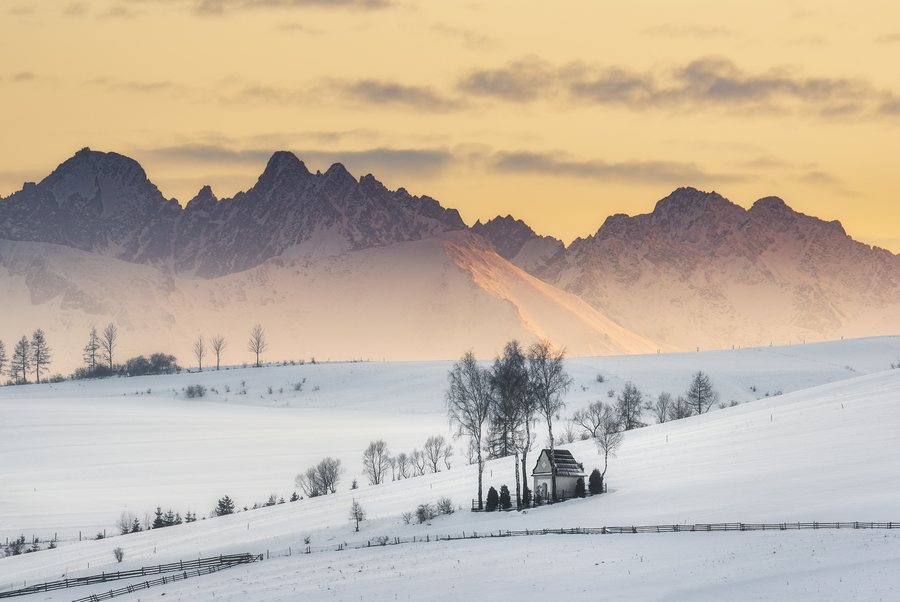 File:Kaplica Matki Boskiej Śnieżnej w Kacwinie.jpg
Photo: Gswito via Wikimedia Commons, CC BY-SA 4.0
Traditional Architecture and Churches
The open-air museum in Kacwin showcases traditional Sypańce. These are wooden buildings plastered with clay, standing on stone foundations and featuring movable sloping roofs. This building style has several distinct elements: wood describes the building’s structure, clay the plaster layer, and stone the foundation; the movable sloping roof defines its exterior form. The term Sypańce therefore does not simply mean any old house, but refers to the building style displayed in the museum, with these specific features. For visitors interested in traditional architecture, the combination of materials and form offers a concrete starting point for a closer look at the buildings.
The Church of All Saints in Kacwin is a Gothic church that was altered in the Baroque period. It was built by the Berzewicz family around 1400. A coat of arms bearing three roses on the keystone of the presbytery vault is considered an indication of their patronage. A keystone sits at the apex of a vault, so the heraldic clue is associated with a specific architectural element. The approximate construction date of around 1400 and the later Baroque alterations provide two points in its chronology. Gothic and Baroque here do not refer to two separate churches, but to the Gothic classification and the later alterations of the same building.
The Chapel of the Holy Trinity was built in 1767 and is located on the northern outskirts of Kacwin. Its year of construction provides a second clear point of reference alongside the Church of All Saints, built around 1400. These dates offer a chronological perspective on two religious buildings in Kacwin.
Waterfall and Trails
There is a waterfall on the Kacwin stream, near a church and a bridge in Kacwin. Along with the historic buildings, it adds a natural feature by the stream to the village’s points of interest.
Two different walking times are given for route planning. A circular walk through Kacwin takes about an hour and a half. A blue hiking trail also leads from Kacwin to the Nad Łapszanką Pass; the walking time is three hours. The routes differ both in their course and in the stated time required: one is a circular walk through the village, while the other leads to a specifically named pass. This lets you weigh the desired walking time against your tour’s destination, rather than treating the two routes as interchangeable.
Before setting out on a hike, it is advisable to check trail conditions. On the blue hiking trail, you should also check the current markings on site.
Discover more destinations: Niedzica, Tylka, Czorsztyn, Łapsze Niżne, Maniowy, Mizerna, Zaskale, Bańska Niżna.
For the broader travel overview: Nowotarski.

