
Perugia for a Ski Holiday: Ski Hotel, World Heritage and Museums
Accommodation in Perugia
Perugia offers a multifaceted gateway to art, urban history, archaeology and Umbria’s distinctive landscapes. Sacred sites, Etruscan relics, medieval buildings, modern culture and the islands of Lake Trasimeno come together to create a varied destination for visitors interested in culture.
Culture
The Palazzo della Penna preserves six panels by Joseph Beuys. They originate from his performance with Alberto Burri, which took place on 3 April 1980 in the Rocca Paolina. The Fontana Maggiore also offers an insight into art history: the lower basin is decorated with relief panels by Nicola Pisano and Giovanni Pisano. The depictions show the twelve months of the year, each together with its corresponding zodiac sign.
The Rocca Paolina can be traversed inside because it incorporated houses, towers and streets from a medieval district. Its history is documented by the Museum of the Rocca Paolina. The upper part of the Porta Marzia was also integrated into the fortress façade. The portal is an Etruscan gate dating from the 3rd century BC. The Pozzo Etrusco is regarded as an important example of Etruscan hydraulic engineering and architectural technology; visitors receive an introduction through an explanatory video.
History
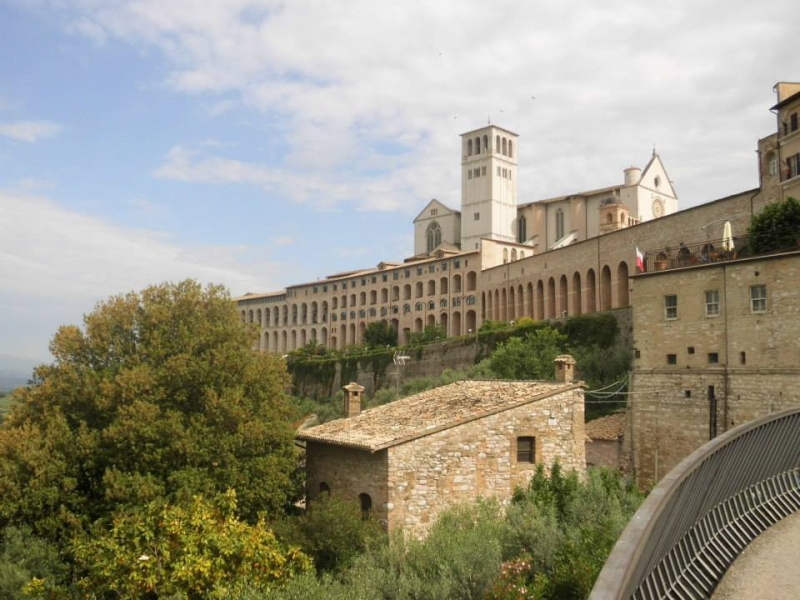
Through the World Heritage Site “Assisi, the Basilica of San Francesco and Other Franciscan Sites,” Perugia is part of an important spiritual and art-historical context. The World Heritage Site is associated with Saint Francis and includes medieval masterpieces by Cimabue, Pietro Lorenzetti, Simone Martini and Giotto. The sites included are the Basilica of San Francesco, the Basilica of Santa Chiara, the Rocca Maggiore, the Eremo delle Carceri hermitage, San Damiano, Rivotorto and the Basilica of Santa Maria degli Angeli. The area covers 14,563 hectares and has a buffer zone of 4,087 hectares.
Archaeological traces are presented particularly vividly at the M.A.N.U. Museo Archeologico nazionale dell’Umbria. The museum reconstructs the tomb of the Cai Cutu family from the 3rd to the 1st century BC, including the grave goods. At the Cattedrale di San Lorenzo, the cathedral and its artworks are open to visitors. The offerings also include the Museo Capitolare with archaeological excavations and a virtual tour.
Museums and Education
The Terre del Perugino-Trasimeno musei network connects more than 30 cultural institutions in six municipalities. The institutions share a common operator and are linked by a joint admission ticket. The Casa Museo Palazzo Sorbello offers a different perspective: in an aristocratic palace with frescoed rooms and views over Perugia and the Assisi Valley, paintings, porcelain, printed works, manuscripts and embroidered textiles are displayed.
The POST – Perugia Officina della Scienza e della Tecnologia is an interactive science museum run by the city and province of Perugia. At the same time, it is considered the region’s most important institution for science communication. The Arco dei Funari adds a freely accessible open-air site to the cultural attractions. It can be reached via Via Vibi by people with mobility impairments.
Historical topics are also presented on an ongoing basis. The Centro di Documentazione Permanente sulla Battaglia del Trasimeno e Annibale houses a permanent exhibition on the Hannibalic era and regularly hosts meetings, conferences, discussions and presentations.
Nature
Isola Polvese can be reached by boat from the piers in San Feliciano, Passignano sul Trasimeno and Castiglione del Lago. The restored Ex Chiesa Santa Maria della Cerqua serves as a point of orientation for the island’s hiking trails. The restored buildings house public services, classrooms, scientific laboratories and offices.
Several buildings bring together landscape, history and interpretation. Castello di Difesa has a cantilevered steel footbridge restored in 1999. It makes the battlement accessible and safe for visitors. The courtyard of Castello di Difesa is used as an open-air theatre for performances and concerts. The Chiesa di San Giuliano preserves a section of Roman opus reticulatum in the retaining wall of its forecourt.
The façade, the outer perimeter walls, part of the apse and a crypt have survived from the Monastero di San Secondo o degli Olivetani. The San Secondo complex is located on the highest part of Isola Polvese and comprises the 12th-century Chiesa di San Secondo and the 15th-century Olivetan monastery, Monastero di San Secondo.
Places
On Isola Polvese, Villa Biagiotti and Ex Fagianaia are also notable stops. Villa Biagiotti is a manor house built in the 1940s in gardens designed by landscape architect Pietro Porcinai. The restored Ex Fagianaia now serves as a multimedia classroom and as a centre for education based on experience and investigation. The restored Roccolo di caccia is now used for educational birdwatching and is accessible to people with disabilities.
Solomeo is a medieval village in the province of Perugia with a castle and terracotta-paved lanes. The Foro delle Arti was built there by Umbrian artisans who took inspiration from the British artists William Morris and John Ruskin. The Teatro Brunello Cucinelli is the central monument of the Foro delle Arti complex in Solomeo and seats more than 200 people.
Another historical route is provided by the Percorso storico-archeologico della Battaglia del Trasimeno. The trail includes nine rest areas where various topics relating to the battle and the history of the landscape are explained.
For further regional navigation, you can also visit Popoli, Norcia, Castelluccio, Savelli and Preci.
For the overarching travel overview: Umbria.
