
Siena between Gothic architecture, the Palio and pilgrimage history
Accommodation in Siena
The historic centre of Siena preserves the Gothic appearance it acquired between the 12th and 15th centuries. Siena developed on three hills connected by three main roads in a Y shape, which meet in a valley at Piazza del Campo.
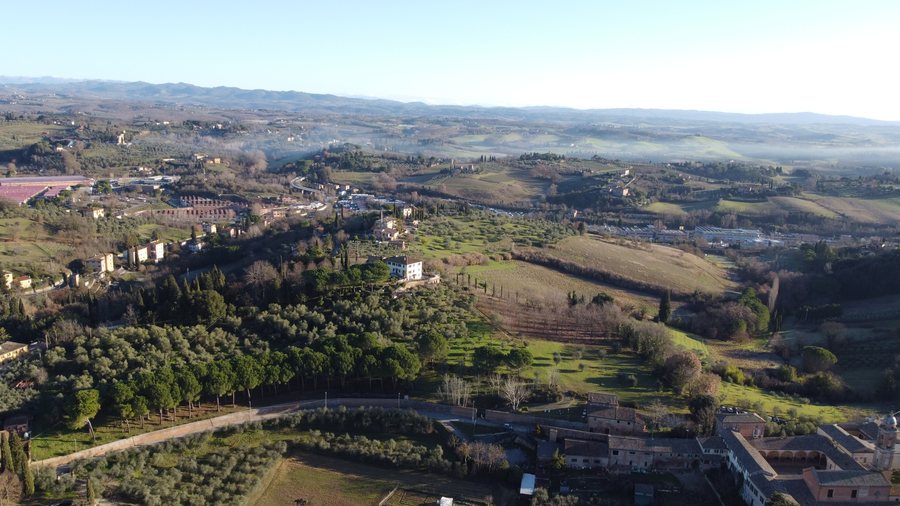 File:View from the Certosa on Maggiano, village in Siena, Italy.jpg
Photo: Alerove via Wikimedia Commons, CC BY-SA 4.0
File:View from the Certosa on Maggiano, village in Siena, Italy.jpg
Photo: Alerove via Wikimedia Commons, CC BY-SA 4.0
Other places: Piancastagnaio, Castiglione D'orcia, Abbadia San Salvatore; also Massa-Carrara, Grosseto, Lucca and Pistoia.
Culture
The Palazzo Pubblico was built between 1297 and 1310. The Torre del Mangia is 87 metres high; including the lightning conductor, its height is 102 metres. The museum tour of the Museo Civico includes a monumental 14th-century loggia offering wide views over the valley behind the Palazzo Pubblico. The Museo Civico houses an extensive fresco cycle by Ambrogio Lorenzetti from 1338 to 1339, depicting the allegory of the government of the “Nine” and its effects on the city and countryside. The Porta del Cielo offers a tour over the cathedral roofs with panoramic views inside and outside the cathedral.
The Museo delle Biccherne displays 106 painted wooden panels that were used as covers for account registers from the 13th to the 17th century. In the Sala Dantesca in the State Archives of Siena, the testament of Giovanni Boccaccio, documents relating to episodes or figures from Dante’s Commedia, and writings by Santa Caterina and San Bernardino are on display. Today’s Santa Maria della Scala museum displays the original statues created by Jacopo della Quercia for the Fonte Gaia. Santa Maria della Scala was a hospital for pilgrims and is now a museum.
Events
At the Palio on 2 July, ten of Siena’s 17 Contrade compete. The Palio race consists of three laps around Piazza del Campo. For the Palio races on 2 July and 16 August, Piazza del Campo is covered each year with a layer of earth made from a mixture of tuff and sand. The Drappellone is an original painting on silk and is presented to the winning Contrada of the race on 2 August.
The recurring “Mercato nel Campo” takes place on the first weekend of December in Piazza del Campo and presents food and craft products in a tradition reminiscent of medieval markets.
History
The Bottini are an underground aqueduct network more than 25 kilometres long that supplies Siena’s fountains and water points. Some sections of the Bottini can be explored on foot; access is via guided tours with limited group sizes. The Via Francigena passes through Siena and is a historic pilgrimage route along which pilgrims from Western Europe travelled to Rome.
Nature
The collections of the Museo di Storia Naturale dell’Accademia dei Fisiocritici are divided into the main areas of geology, zoology, anatomy and botany, as well as smaller collections. A reconstructed medieval urban garden has been created at the Orto de’ Pecci.
Getting around
Access to the Museo delle Biccherne exhibition is accompanied by staff throughout the entire visit. For Siena’s historic centre, there is a plan for pedestrian and cycle traffic in connection with measures to control motor vehicle traffic. Siena railway station is approximately 2 kilometres from the city centre.
For the higher-level travel overview: Tuscany.

