
Alessandria between Fortress Culture and Piedmontese Landscapes
Accommodation in Alessandria
Alessandria combines striking fortress architecture, urban history, art, and diverse landscapes. The Cittadella di Alessandria is one of the most significant European monuments of permanent 18th-century fortification architecture. It was built following the Treaty of Alliance concluded in 1703 during the War of the Spanish Succession.
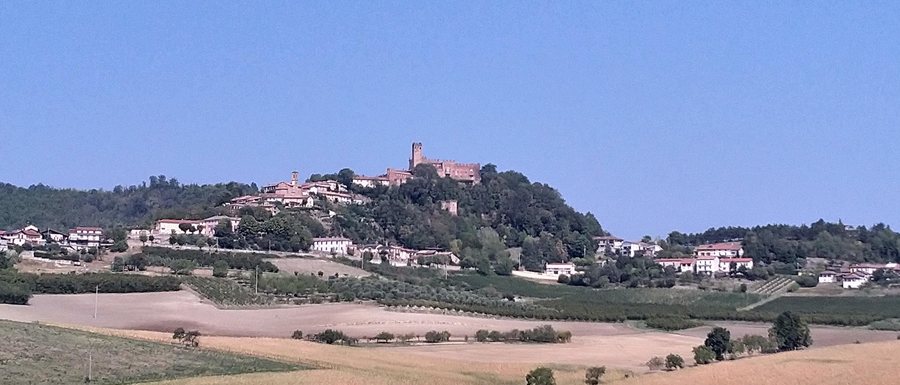 File:Panorama di Camino, località in provincia di Alessandria, Italia.jpg
Photo: AndreaKaltz via Wikimedia Commons, CC BY-SA 4.0
File:Panorama di Camino, località in provincia di Alessandria, Italia.jpg
Photo: AndreaKaltz via Wikimedia Commons, CC BY-SA 4.0
Culture and History
The Borsalino Museum also introduces visitors to a distinctive chapter of the city’s history. The multimedia museum is dedicated to the history of the Italian hat brand Borsalino and opened in 2023 on the initiative of the City of Alessandria and the Fondazione Borsalino. The Marengo Museum presents the history of the Italian campaign of 1800 and the Battle of Marengo, including its causes, developments, and consequences. It is located in the centre of the battlefield near the village of Marengo and is housed in Villa Delavo, which was built in 1847 as a monument to the emperor. Videos, maps, graphic works, weapons and objects, figures in historical uniforms, and films bring the battle vividly to life.
Palatium Vetus is considered the oldest public palace in the city of Alessandria. Its art collection comprises more than 800 works dating from the 15th century to the present day. The historic seat has been reopened to citizens, students, and tourists; the historic seat, its remains, and the art collection are open to visitors. Parts of the original medieval core were uncovered, including triforium windows, frescoes, and interior decorations.
The Sale d'Arte are open to the public and display significant works and art objects from the collections of Alessandria. These include late-medieval wall frescoes from the late 14th century inspired by the stories of King Arthur. The Sale d'Arte also present paintings by Giovanni Migliara (1785–1837) and explore 19th-century genre and landscape painting. A step-free side entrance with a ramp and lift is available; the exhibition rooms can be visited independently.
A selection of castles and palaces in the Province of Alessandria is based on historical, artistic, and architectural significance, as well as on available opening hours or structured reservation options.
Science
The Teatro delle Scienze comprises the Museo di Scienze Naturali, a planetarium, and an astronomy laboratory. The Museo di Scienze Naturali offers a natural history tour featuring rocks, minerals, and fossils, as well as a scale model of the river landscape of the Alessandria area. In the planetarium, a starry sky with 6,500 stars is projected; constellations and celestial movements can also be simulated. The entrance and interior spaces of the Teatro delle Scienze are easily accessible for people with disabilities. There is also a bathroom suitable for people with reduced mobility.
Landscapes and Routes
The Province of Alessandria includes plains, hills, and mountainous areas with different histories, traditions, and cultures. It offers trekking and cycling experiences through vineyards and historic villages as well as through diverse landscapes. The Percorso Borsalino begins at Palazzo Rosso and passes the historic Borsalino hat shop on Corso Roma in Alessandria. The route follows the panoramic Strada Comunale Bricchi; along the way, the paved road partly turns into an unpaved path.
The Anello di Rivarone is a circular route in the hills around Rivarone and can be reached from Alessandria via provincial road SP80. On the CAI 575 circular route at I Calanchi di Merana, the paths lead through spectacular erosional badlands and to numerous geological formations locally known as “Murion”.
Region and Getting There
The Province of Alessandria lies in southern Piedmont, at the centre of the triangle between Turin, Milan, and Genoa. The A21 Turin–Piacenza, A26 Genoa Voltri–Gravellona Toce, and A7 Milan–Genoa motorways cross the area. In Piedmont, the UNESCO vineyard landscape of Langhe-Roero and Monferrato preserves viticulture and winemaking traditions developed over a long period.
Forte di Gavi has a star-shaped polygonal ground plan with six pointed bastions connected by curtain walls.
You can find additional location pages for Garadassi, Montecapraro, San Sebastiano Curone, and Fabbrica Curone. Further destinations can be reached via Novara, Turin, Asti, and Vercelli.
For the overarching travel overview: Piedmont.

