
Cecciola: Chestnut Tradition, Stone Architecture and Mountain Views
Accommodation in Cecciola
Cecciola combines a striking mountain setting with farming traditions, historic stone architecture and paths leading to notable traces of local history. When choosing accommodation in Cecciola, you will find several points of interest in the village itself for a stay combining village sightseeing, chestnut culture, landscape and regional craftsmanship.
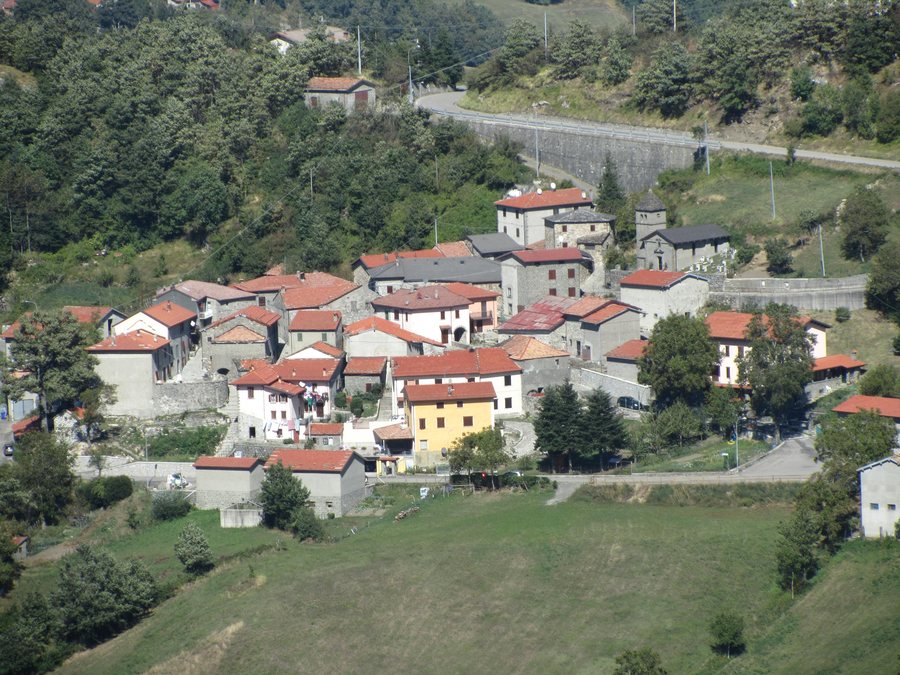
Cecciola between Monte Lungo and the Liocca
Cecciola lies on the western slopes of Monte Lungo, on the right bank of the Torrente Liocca and opposite Miscoso. This location shapes the orientation on site: The stream is just as much part of the spatial setting as the slopes and the settlement opposite. The Val d'Enza, also known as the “Valley of the Knights”, leads via the SP 15 to the stone village of Cecciola.
When arriving from the direction of Ramiseto, the SP 15 leads towards P.sso del Lagastrello to a signposted turn-off for Cecciola. This road connection is also relevant when planning a stay if you want to consider the village as a starting point for visiting its historic buildings and paths.
Stone Architecture and Historic Village Details
The historic centre of Cecciola includes vaulted passageways, courtyards, loggias and cobbled lanes. The portals, windows and wayside shrines on the houses are particularly notable.
The small Church of Maria Assunta is also one of the specific stops in the village. Its façade features an intricately crafted stone portal dating from 1885. The oldest portal identified in Cecciola to date is dated 1592.
Metati and the Chestnut Tradition
In Cecciola, a metato is a building used to dry chestnuts. The Metato di Cecciola has been restored, returned to its original function and is currently in operation. Historically, it also served as a meeting place for evening “Veglie”, when young and old gathered and told stories beside the warm embers.
Chestnut drying in Cecciola is still associated with two stone, wood-fired metati that are used every year. Dried chestnuts are produced from them. The chestnuts dried in Cecciola are also used to make chestnut flour, as well as biscuits, pasta, confectionery, beer and liqueur. Those interested in regional foods can therefore view the chestnut here as a raw material, a craft tradition and an ingredient in various products.
The Mulino Briselli di Cecciola
Another historic site is the Mulino Briselli di Cecciola. It dates from the 19th century and began operating in 1853. The mill was almost completely destroyed by the 1972 flood; however, its equipment and mechanisms have survived. It is precisely this combination of a severely damaged building structure and preserved technical equipment that makes the mill an informative destination for visitors interested in former working processes and regional history.
The Mulino Briselli di Cecciola can be reached via a path leading down from the village of Cecciola to the Torrente Liocca. The path connects the village area with the watercourse and at the same time places a visit to the mill within the landscape. For your planning, the specific route connection is decisive: The mill is not simply another point in the historic centre, but can be reached via the described descent from the village to the Torrente Liocca.
Museum and Accommodation at the Centro
The Centro per il Turismo Rurale di Cecciola houses a small museum with old farming tools and household equipment recovered in the Cecciola area.
The accommodation units of the Centro per il Turismo Rurale di Cecciola can be booked individually or as an entire complex for up to 60 people. This information is particularly important when choosing the appropriate type of accommodation: Individual units and shared use of the entire complex cater to different group sizes and stay plans. Accommodation in Cecciola can therefore be directly combined with the village's cultural focus, without assuming any additional features of the accommodation.
View from the Church
There is a viewpoint next to the church of Cecciola. From there, you can see the ridge of Monte Casarola, Alpe di Succiso and Monte Acuto. Their profiles form the border with Lunigiana.
For a comparison with other places, you can also view La Villa and Viano.
For the overarching travel overview: Reggio Emilia.

