
Lillafüred: Waterfall, Caves and Forest Railway
Accommodation in Lillafüred
Highlights range from a striking landscape feature to an exhibition about Ottó Herman. The differences below can help you choose suitable areas of interest for your stay.
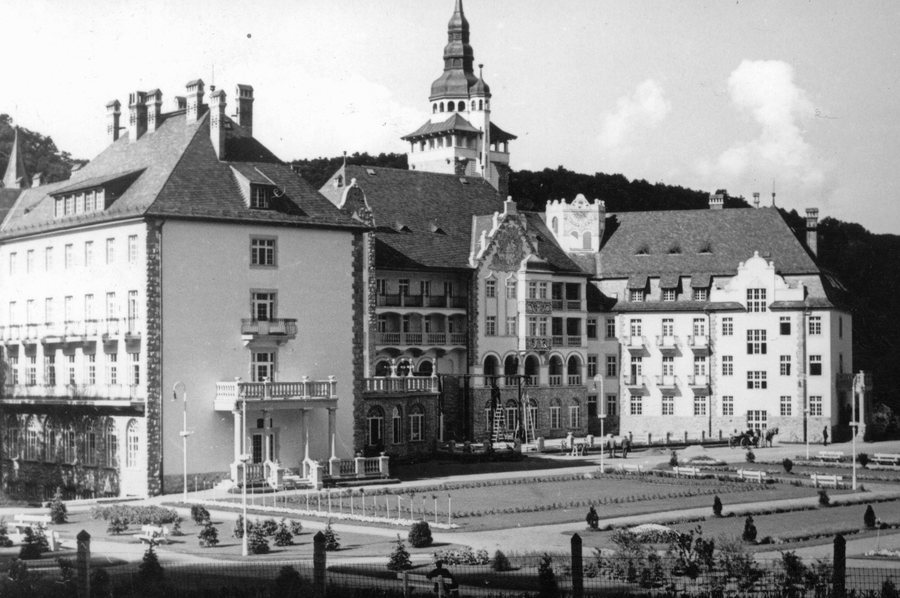 Palotaszálló a park felől. Fortepan 9285.jpg
Photo: FOTO:Fortepan — Lissák Tivadar via Wikimedia Commons, CC BY-SA 3.0
Palotaszálló a park felől. Fortepan 9285.jpg
Photo: FOTO:Fortepan — Lissák Tivadar via Wikimedia Commons, CC BY-SA 3.0
Waterfall, lake and hillside garden
The Szinva Waterfall in the Palotaszálló park is 20 metres high. It was formed by the river flowing over a rock face. In 1928, the new channel of the Szinva formed the park boundary; the river shaped the waterfall on the rock face. If you are interested in the interplay between landscape and design, this is a concrete example of the connection between the park, river channel and rock face.
Hámori Lake also shapes the appearance of Lillafüred. The lake is an artificially dammed section of the Garadna stream. This means two distinct types of water feature sit side by side in the local landscape: the dammed section of stream and the waterfall, whose formation is linked to the river channel and rock face.
Below the Palotaszálló, the hillside is laid out as a terraced garden. It descends in stages to the entrance of the Anna Cave. The terraces make the change in elevation between the hillside and the cave entrance part of the local landscape design.
Forest railway, chairlift and trails
The Lillafüred State Forest Railway winds through the Garadna Valley, along the shore of Hámori Lake. It offers a way to travel to the Palotaszálló, the waterfall, the caves and the Újmassai őskohó. For your planning, this is a distinct way to connect the destinations mentioned above with a journey through the valley;
The trails also differ in their starting and ending points. The Lillafüredi Tanösvény begins at the Lillafüredi Szent Anna Cave and ends at Lillafüredi Libegőpark. The Oxigén-sétaút begins at the upper station of the Lillafüredi Libegő. Its name refers to Lillafüred’s role as a climatic health resort. If you would like to include trails in your trip, their respective starting points can help you choose among local attractions based on your interests.
The chairlift between Lillafüred and Jávorhegy, which rises above the resort area belonging to Miskolc, carries passengers over a distance of one kilometre. This figure describes the length of the route. The Lillafüredi Tanösvény and the Oxigén-sétaút, by contrast, each have a named starting point and, in the case of the Tanösvény, a named endpoint.
Caves and local history
Anna Cave is a tufa cave open to the public. Its cavities were formed by the vaulting of waterfalls. Moss, pine needles and intertwined roots on the walls and ceilings create a striking sight inside. The cave thus brings together a specific geological formation and the shapes visible within it.
At Szent István Cave, the section open to visitors is 170 metres long. The Lillafüredi Szent Anna Cave is also the starting point of the Lillafüredi Tanösvény; the length given, however, refers to the section of Szent István Cave open to visitors.
The Miskolc–Lillafüredi Tanösvény in the Szinva Valley introduces visitors to several topics related to the area: the formation of the Szinva Waterfall and Anna Cave, the history of the Palotaszálló and the Lillafüred State Forest Railway, and the construction of the Lourdes-i barlang and the Limpiászi kereszt. The area’s geological formations are also covered. This may help with your choice if you would like to explore natural features and local history together.
The Pele House was Ottó Herman’s former holiday home in Lillafüred. It was built between 1898 and 1903 as part of the newly established holiday resort at the time. The former holiday home houses an exhibition about his scientific work as well as his political and public activities. This adds a biographical perspective to the area’s natural and trail-related attractions.
For the broader travel overview: Miskolci.

