
Probstzella: Bauhaus, Border History and the Slate Trail
Accommodation in Probstzella
Probstzella combines Bauhaus architecture and regional history with hiking trails and a landscape that is part of the Green Belt. This gives your trip planning a clear thematic focus: you can explore the architecture of the Haus des Volkes, learn about local and border history in museums, or focus on trails around Probstzella.
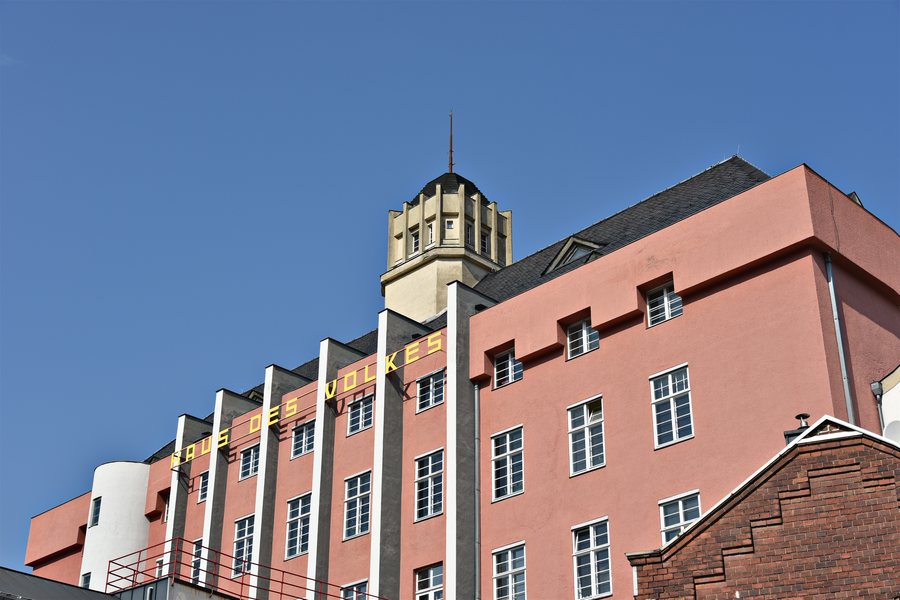 File:Haus des Volkes, Probstzella (Thüringen), Bahnhofstr. 25.jpg
Photo: Matthias Krug-Bamberg via Wikimedia Commons, CC BY-SA 4.0
File:Haus des Volkes, Probstzella (Thüringen), Bahnhofstr. 25.jpg
Photo: Matthias Krug-Bamberg via Wikimedia Commons, CC BY-SA 4.0
Bauhaus architecture at the Haus des Volkes
The Haus des Volkes was built between 1925 and 1927 as a hotel and community center. Bauhaus student Alfred Arndt was involved as the architect. The building, completed in 1927, is Thuringia’s largest Bauhaus ensemble. It contains a theater and a concert hall. This combination of Bauhaus architecture and shared spaces makes the building an important point of reference if you are interested in architectural history.
The Haus des Volkes combines architectural history with its former role as a community gathering place.
Museums: railway station, everyday life and slate mining
The Probstzella GDR Border Railway Station Museum is housed in the old railway station building, dating from 1885. Its location reflects the station’s history as a border station in the GDR. The local history museum, meanwhile, focuses on local history and slate mining in the Probstzella area. There, visitors can follow the traces along the former inner-German border.
The local history museum also recreates Probstzella’s former post office and a grocery store. The exhibition includes about 120 meters of railway track and around 2,000 trees, as well as numerous faithfully reproduced houses from Probstzella. These details give local history a tangible, vivid form. The museum offers guided tours of the exhibition on request. If you are looking for background on slate mining, the local history museum also explains its history in the Probstzella area.
The Green Belt and trails around Probstzella
The landscape near Probstzella is part of the Green Belt. During the decades of border restrictions, particularly valuable biotopes developed along the former border strip. This means that, alongside the historical sites, the landscape’s response to the former border situation is also in focus. Guided border hikes around Probstzella can be arranged on request with trained nature guides. This option combines hiking with an exploration of border history, without requiring you to follow a specific route.
The Slate Trail includes a short circular route around Probstzella, which takes about two to four hours. The Slate Trail is also laid out as a longer circular route of about 60 kilometers, connecting Probstzella with Lehesten, Ludwigsstadt and Gräfenthal. These different figures refer to different types of routes: the short circular route near Probstzella and the longer, larger loop. When planning your trip, you can therefore choose between a route with a stated, manageable duration and a more extensive hike, without treating the two as the same route.
Another option in the surrounding region is the Loquitz cycling trail, which can be explored on foot or by bicycle. It offers a different way to discover the region than the Slate Trail.
More local pages: Meura, Oberweißbach/Thuringian Forest, Saalfelder Höhe, Leutenberg, Lichtenhain, Meuselbach-Schwarzmühle, Lichte and Barigau.
For the broader travel overview: Saalfeld-Rudolstadt.

,_Bahnhofstr._25.jpg)