
Wildenranna: Village Center, Church and Trails
Accommodation in Wildenranna
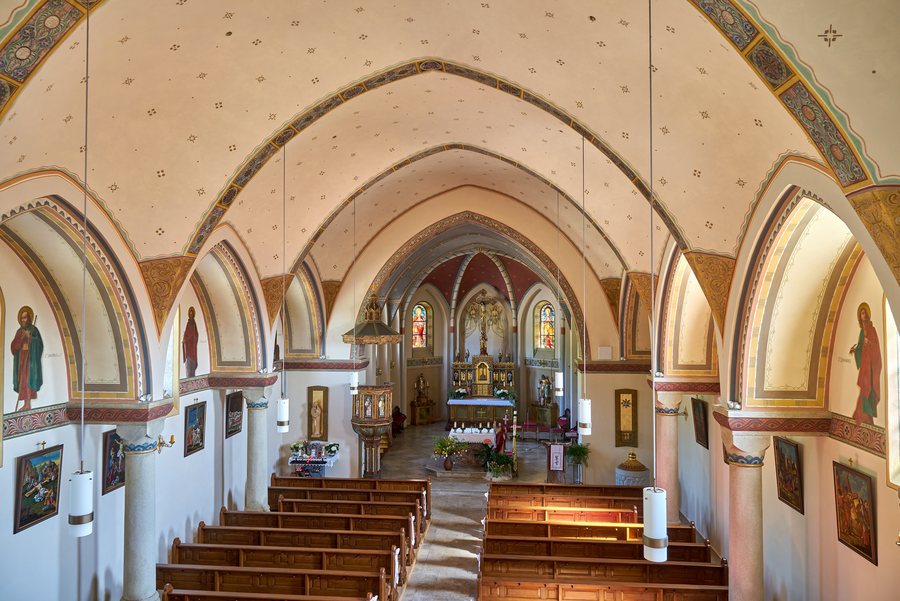 File:Wegscheid, Wildenranna, Kirchenweg 7, Pfarrkirche Maria Schmerzensmutter 1.3.jpg
Photo: Georg Karl Ell via Wikimedia Commons, CC BY 4.0
File:Wegscheid, Wildenranna, Kirchenweg 7, Pfarrkirche Maria Schmerzensmutter 1.3.jpg
Photo: Georg Karl Ell via Wikimedia Commons, CC BY 4.0
If you are looking for accommodation in Wildenranna, you can plan your stay around historic village scenery, a documented hiking trail and a cycling connection. The village center, the Parish Church of Mary of Sorrows, the W8 Sumpfwiesenweg circular hiking trail and the Danube-Moldau Cycle Route offer different points of interest for your trip. This allows you to decide before booking whether you would prefer to focus on culture, a hike or a bike tour.
Key facts on the topic
- The Wildenranna village center ensemble is a village complex rebuilt after the major village fire of 1898.
- The Parish Church of Mary of Sorrows was built in 1904–1906 in Romanesque and Gothic forms.
- The original version of the church furnishings was uncovered in Wildenranna Parish Church.
- The free-standing war memorial on the south side of the parish church was completed in 1985 and inaugurated on 25 May 1986.
- The W8 Sumpfwiesenweg begins at a free hiking car park in Wildenranna.
- The W8 Sumpfwiesenweg passes a nature reserve for freshwater mussels.
- The Danube-Moldau Cycle Route runs between Obernzell and Wildenranna for approximately 8 km.
- Approximately 5.5 km of this section follow a former railway line.
Historic Village Center and Parish Church
The Wildenranna village center ensemble conveys the history of a village complex that was rebuilt after the major village fire in 1898. The village center is therefore not merely a place name for planning your trip, but a cultural focus in its own right during your stay. If you are interested in the development of rural settlements and historic village scenery, you can plan your visit as a peaceful activity alongside outdoor pursuits.
Another prominent point of interest is the Parish Church of Mary of Sorrows. It was built in 1904–1906 in Romanesque and Gothic forms. The original version of the church furnishings was also uncovered in Wildenranna Parish Church.
Hiking and Cycling in Wildenranna
For a hike, the W8 Sumpfwiesenweg circular hiking trail is a practical option for planning. The trail begins at a free hiking car park in Wildenranna. This is relevant to your preparations because you can take the starting point into account before planning your day. Another special feature of the trail is the nature reserve for freshwater mussels, which the W8 passes. Those who want to combine scenery with observing nature will find a clearly described focus for their stay here.
There is also a named connection for a bike tour: the Danube-Moldau Cycle Route runs between Obernzell and Wildenranna for approximately 8 km. Of this distance, approximately 5.5 km follow a former railway line. You should retain these approximate figures when planning your day. They describe the length of the section mentioned, but say nothing about travel time, gradients or current trail conditions.
Culture and Remembrance Around the Church
A free-standing war memorial is located on the south side of the parish church. Construction was completed in 1985, and the memorial was inaugurated on 25 May 1986. There are also memorial plaques on the church wall for participants in the wars of 1870/1871, the First World War and the Second World War. These various memorial sites are among the historic points of interest you can include in a culturally focused tour.
The combination of the rebuilt village center, parish church, uncovered original church furnishings and memorials provides several different themes for a stay. You can decide for yourself whether to focus on architecture, local history, church furnishings or remembrance culture. This kind of choice is particularly helpful when not all travelers share the same interests.
Finding Accommodation to Suit Your Plans
When searching for accommodation in Wildenranna, you can first determine what you plan to do during the day. For those interested in culture, the village center and parish church are the main attractions. For planning a hike, the W8 Sumpfwiesenweg and its starting point are important details. If you want to travel by bicycle, the section of the Danube-Moldau Cycle Route between Obernzell and Wildenranna provides its own planning framework. This allows you to choose your accommodation according to the purpose of your trip without assuming unverified features or distances.
FAQ
What is the Wildenranna village center ensemble?
The Wildenranna village center ensemble is a village complex rebuilt after the major village fire in 1898.
When was the Parish Church of Mary of Sorrows built?
The Parish Church of Mary of Sorrows was built in 1904–1906 in Romanesque and Gothic forms.
Where does the W8 Sumpfwiesenweg begin?
The W8 Sumpfwiesenweg circular hiking trail begins at a free hiking car park in Wildenranna.
What does the W8 Sumpfwiesenweg pass?
The trail passes a nature reserve for freshwater mussels.
What is the route of the Danube-Moldau Cycle Route near Wildenranna?
The cycle route runs between Obernzell and Wildenranna for approximately 8 km. Approximately 5.5 km of it follow a former railway line.
What memorials are located at the parish church?
A free-standing war memorial stands on the south side. The church wall also has memorial plaques for participants in the wars of 1870/1871, the First World War and the Second World War.
To the higher-level travel overview: Wegscheid.

