
Marktleugast: Nature Trails and Church Art
Accommodation in Marktleugast
Marktleugast combines an extensive network of hiking and cycling trails with nature experiences and a remarkable ecclesiastical art heritage. The following destinations illustrate the themes that can shape a stay in Marktleugast.
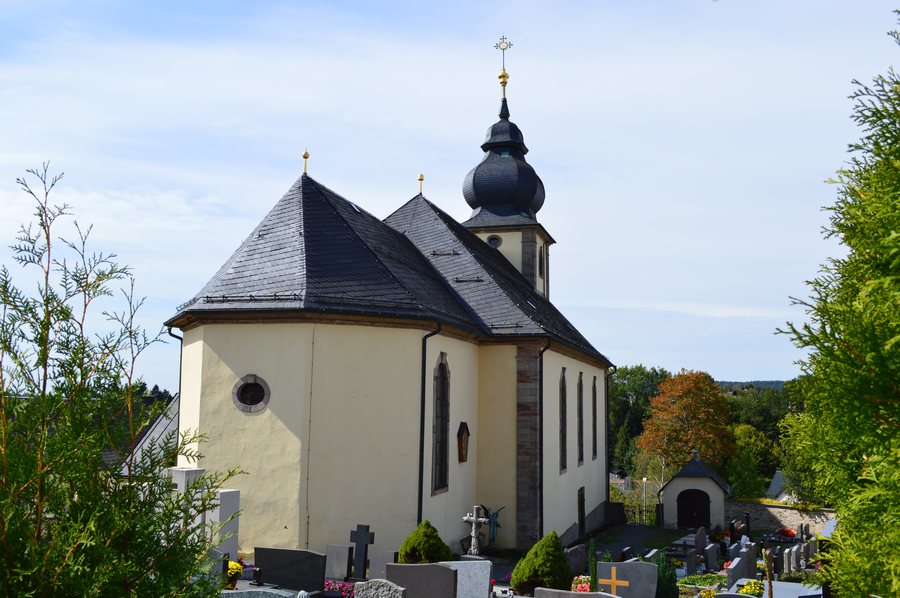 St. Bartholomäus und Martin Marktleugast & Nebengebäude
Photo: Micha m z via Wikimedia Commons, CC BY-SA 4.0
Experience Nature and Discover Trails
Marktleugast is located in the Frankenwald Nature Park. An extensive network of hiking and cycling trails leads through a varied landscape. If you enjoy spending time outdoors, you can take this general character into account when choosing where to stay.
In Marienweiher, the “Zechteich” nature trail offers an opportunity to learn more about the habitat and the animals native to the area. This provides a different focus from a hike or bike ride: here, learning about nature takes centre stage. Fishing is also possible at Zechteich. Fishing permits for the pond are available from the Marktleugast administrative community. Check the fishing permit arrangements before you arrive if you plan to include fishing in your itinerary.
Churches and Art in Marktleugast
The Bethlehem Church in Mannsflur combines architectural history with several specific works of art. Its foundation stone was laid on 10 May 1959. The altar, ambo and baptismal font were created by Hans Rucker, a Marktleugast sculptor born in Marktleugast in 1931.
Another work in the Bethlehem Church is the “Noah’s Ark” mosaic. It is made of coloured ceramic stones, was designed by Konrad Ehmann and dates from 1969. Together with Rucker’s works, it offers another way to appreciate the church: alongside its history, you can consider the different artists, materials and dates of creation of the works of art.
The present-day St. Bartholomew’s Church in Marktleugast also has its own architectural history. It was built and completed between 1762 and 1782. At the top of the altar is an equestrian statue of Saint Martin, which comes from a small old chapel.
Marienweiher: Rococo and Pilgrimage
The parish and pilgrimage church of Marienweiher is a medium-sized Rococo church with a richly decorated, colourful interior. It is a place of prayer, pilgrimage and devotion to Mary. Here, spiritual significance is just as central as the architecture and the effect of the interior. If you are interested in church art, Marienweiher can be compared with the differently characterised works in the Bethlehem Church in Mannsflur: one church is defined by its Rococo style, while the other is distinguished by individual works and their history.
Kulmbach as a Wider Travel Destination
If you are also considering Kulmbach as a wider travel destination, you will find distinct nature and cultural history attractions there. The nature trail on Kulmbach’s Rehberg hill is about four kilometres long and has 21 learning stations. The 11-kilometre “Rehbergweg” circular trail leads from Plassenburg Castle to Rehberg, through Kulmbach’s old town and back to the starting point. At Plassenburg Castle, the German Tin Figure Museum displays more than 300,000 individual figures in around 150 dioramas. These destinations are in Kulmbach and should be distinguished from the places mentioned in Marktleugast.
Choose Accommodation to Suit Your Interests
When choosing accommodation, you can first decide which themes you want to shape your stay: hiking and cycling trails, nature watching at Zechteich, fishing or church architecture. When considering a specific option, check its location in relation to the destinations that matter to you, and plan your journeys accordingly.
Discover more destinations: Thurnau, Kulmbach, Presseck, Untersteinach, Mainleus, Stadtsteinach.
Go to the wider travel overview: Kulmbach District.

