
Discover Honau: Nature, History and Paths around the Echaz
Accommodation in Honau
Honau combines geological features, cave history, paths through the surrounding area and cultural points of interest. When choosing accommodation in Honau, you can shape your stay around very different experiences: the Olgahöhle, the Echaz Spring, the Wilhelm Hauff Museum, a route from Lichtenstein Castle to Honau or the landscape along the former cog railway route.
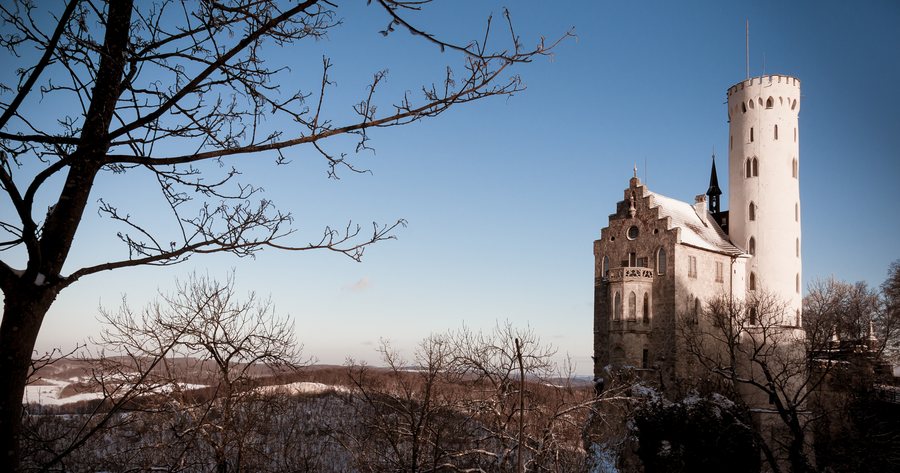 File:Honau Baden-Württemberg Germany Lichtenstein-Castle-in-winters-atmosphere-01.jpg
Photo: CEphoto, Uwe Aranas via Source, CC BY-SA 3.0
File:Honau Baden-Württemberg Germany Lichtenstein-Castle-in-winters-atmosphere-01.jpg
Photo: CEphoto, Uwe Aranas via Source, CC BY-SA 3.0
Honau between limestone tuff and the Echaz
Honau is situated on an approximately 18-hectare limestone tuff bar. This is a sedimentary rock formed by the Echaz. The limestone tuff bar and the Föhner Spring represent two natural features of the village: the underlying geology and weather-dependent water emergence. This geological feature gives the village a clearly recognisable connection to nature. The Föhner Spring is located near the Honau sports field. It emerges from an opening in the rock after the snowmelt or during prolonged periods of rain. Its appearance therefore depends on the prevailing natural conditions.
At the spring basin of the Echaz Spring, there is a seat for hikers and walkers. The seat at the spring basin provides a fixed point for a break while walking or hiking.
The Olgahöhle: Rock Formations and Cave History
The Olgahöhle in Honau is a special show cave with bizarre rock formations, imposing moss tuff blocks and limestone tuff calottes. The different formations make it an independent destination for visitors interested in nature and the history of the Earth. Guided tours of the cave can be organised on request by the Honau local group of the Swabian Alb Association.
Johann Ziegler discovered the Olgahöhle on 24 October 1874 during quarrying work. Ten years later, the cave was illuminated electrically: in 1884, it became the first electrically illuminated cave in Germany. The history of the Olgahöhle therefore encompasses both its discovery and its early electric lighting.
Paths, Cycling and Destinations below the Castle
The hiking trail from Lichtenstein Castle to Honau is 1.9 kilometres long and takes 26 minutes. The route therefore offers a clearly quantified way to connect Lichtenstein Castle and Honau in one itinerary.
The parallel cycle path on the former cog railway route between Lichtenstein-Honau and Engstingen was once again fully accessible for cyclists and pedestrians. The historic route therefore serves as an independent reference point for cycling and walking paths. The former cog railway route forms a separate connection between Lichtenstein-Honau and Engstingen for cyclists and pedestrians in the surrounding area.
In the Honau district, there is a small, family-friendly swimming pool in a picturesque location below Lichtenstein Castle.
Culture at the Wilhelm Hauff Museum
The Wilhelm Hauff Museum in Lichtenstein-Honau displays works by the writer Wilhelm Hauff in its exhibition. For visitors who do not want to plan their stay exclusively around the landscape and paths, the museum offers a clear literary focus. A free audio guide is also available in German and English.
For the overarching travel overview: Lichtenstein.

