
Kappelrodeck: Vineyards, Hiking Trails and Legends
Accommodation in Kappelrodeck
Kappelrodeck brings together viticulture, local lore and trails through a varied landscape. When planning your visit, it is worth distinguishing between the destinations by their character: the Fruit Trail focuses on fruit and plant life, while the Legend Trail features a local story and changing landscapes. The “Hex vom Dasenstein” vineyard site, meanwhile, links viticulture and legend with the name of Kappelrodeck wine.
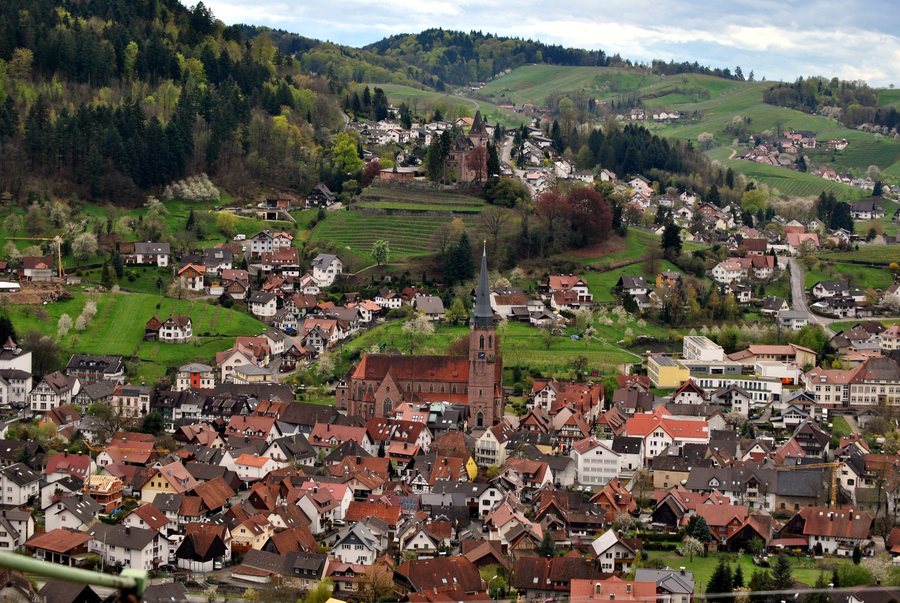 File:Kappelrodeck mit der Kirche St. Nikolaus.jpg
Photo: Gelicious via Wikimedia Commons, CC BY-SA 4.0
Fruit Trail and Hiking Trails
The Fruit Trail runs through the districts of Kappelrodeck and Waldulm; its actual starting point is in Kappelrodeck, below Brandrain. Along the trail, there is a three-part information board and a biotope. Other features include wild roses and native trees, wild bee and honeybee hives, stone fruit trees bearing plums and cherries, as well as other shrubs and hedgerows with wild berries. The board and biotope complement the fruit trees with further insights into plant life and nature along the trail.
The Dasenstein Legend Trail starts at Kappelrodeck railway station, which is easily accessible by public transport. This short, scenic hike leads through the vineyards outside Kappelrodeck and across a changing landscape of forest and vines, mountains and valleys. On the multimedia legend walk, you can experience the legend of the Hex vom Dasenstein using a Wi-Fi-enabled smartphone or tablet. According to the legend, the witch gave Kappelrodeck wine its name.
The Kappelrodeck Hexensteig quality hiking trail connects the Achertal and Renchtal valleys. The trails therefore differ in their focus as described here: the Legend Trail emphasizes a short hike, a start at the railway station and a changing landscape, while the Hexensteig is defined by its link between the two valleys.
Viticulture and the Legend of Dasenstein
The vineyards in the “Hex vom Dasenstein” site around Kappelrodeck cover 180 hectares and are cultivated by around 80 wine-growing families. Nearly 80 percent of Kappelrodeck’s vineyard area is planted with Pinot Noir. This makes viticulture tangible both as part of the landscape and through its cultivation and particularly widespread grape variety. The legend of Dasenstein adds a local story to this connection with wine.
The “Hex vom Dasenstein” wine cellar is considered a wine experience destination. Visitors can also see an extensive collection of medals at the wine cellars in Kappelrodeck and Waldulm. If you are planning a cellar visit, it is best to check current visiting options in advance.
Dasenstein and Rodeck Castle
Dasenstein is a natural monument in Kappelrodeck’s vineyards. Below the natural monument, the Dasenstein hut has seating where you can take a break. This makes a rest stop easy to include as a separate part of exploring the wine-growing landscape. Rodeck Castle, the municipality’s landmark, was built in the 12th or 13th century. It offers another way to explore local history, alongside the legend and the vineyards.
The Ortenau District as a Regional Setting
As a broader travel destination, the Ortenau District lies between the Rhine and the Black Forest. It has 23 nature reserves covering a total area of around 3,110 hectares. They extend from the Rhine plain to the higher elevations of the Black Forest. This regional context complements Kappelrodeck’s specific themes with the wider landscape of the Ortenau District.
Discover more destinations: Ottenhöfen im Schwarzwald, Lauf, Sasbach, Achern, Seebach, Bad Peterstal-Griesbach, Oppenau, Hornberg.
Return to the main travel overview: Ortenau District.
Compare hotels and holiday rentals in Kappelrodeck by price and availability for your travel dates.
Advertisement · We may receive a commission if you book.
