
Polleur – Roman Bridge, Heritage and Walking Trails
Accommodation in Polleur
Polleur combines distinctive historic buildings with walking trails that vary in landscape and route features. When planning your trip, you can therefore weigh up two specific interests: local history and architecture, or the character of the walks described here. The following features provide factual guidance to help you choose your destination.
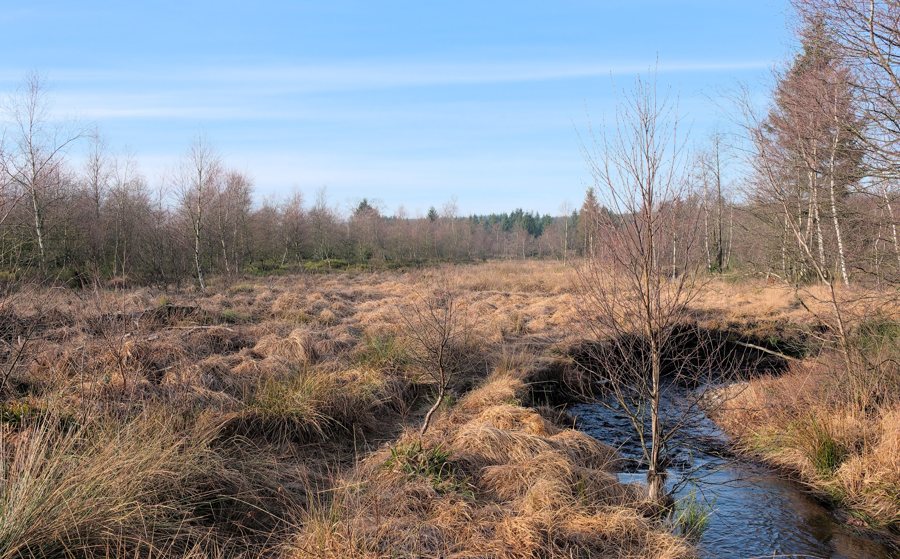 File:Polleur stream, High Fens – Eifel Nature Park (DSCF6647).jpg
Photo: Trougnouf (Benoit Brummer) via Wikimedia Commons, CC-BY-SA-4.0
Roman bridge and historic buildings
The Vieux Pont de Polleur is a Roman bridge in the village centre that crosses the Hoëgne. It lay on the Voie du Fer, an ancient Roman road between Trier and Tongeren. Two basket-handle arches and a gently arched roadway define its structure. The bridge thus brings together a named river crossing and the history of the old road link.
Another landmark is the Congrès de Polleur statue, set slightly back from a stele in Polleur. The Route des Droits de l’Homme is a separate feature: it is marked by sixteen steles, including one in Polleur. Those interested in the village’s history will find two distinct points of reference here—the statue and the route marker.
The Church of Saint-Jacques et Notre-Dame de Polleur is a Gothic building made of sandstone and limestone masonry. Its architectural features include a distinctive spiral bell tower. Since January 1935, the tower and spire have been listed as protected architectural heritage in Theux. There is also a replica of the Grotto of Our Lady of Lourdes in front of the church.
Walks with different characteristics
The routes also have specific differences. Stage 7 of the Chemin des Sources passes through the village of Polleur in the Hoëgne Valley. Polleur Walk No. 40 runs through fields and woodland, leads to the hamlet of Neufmarteau, and reaches the Val de Hoëgne, where it completes its circular route. Its description therefore combines varied scenery with two named places along the route.
Polleur Walk No. 41 passes through the wooded Staneux massif. It crosses several fords and follows the Chawion stream for more than a kilometre. By comparison, No. 41 focuses on the stream, the fords and the woodland; No. 40 is described in terms of fields, woodland, Neufmarteau and the Val de Hoëgne.
Folklore and event dates
The Fête du Coucou is a local folkloric tradition in Polleur, held on the last weekend of July. Check the exact dates of the event before your trip. This lets you include it in your plans without assuming a specific date for a particular year.
L’Année sans… coucou is also held in Polleur: this biennial event alternates with the Fête de la Cour du Coucou. Participants are invited to wear historical costumes for an evening; the programme may vary from one edition to another. If you are interested in this event, check the dates and programme for the specific edition. Together with the buildings and the varied walking trails, these events provide a clear overview of Polleur’s historical and folkloric themes.
Discover other destinations: La Reid.
Go to the main travel overview: Theux.

