
Marul: Hiking, Nature and Cultural History
Accommodation in Marul
When looking for accommodation in Marul, hiking trails, nature and cultural sites can provide useful pointers for planning your trip. These themes are distinct: the Forest Adventure Trail offers various activities and two route options, the hike along the Marulbach leads to the Fuchswaldalpe, and a mountain trail leads into the Faludriga-Nova core zone. The architectural history of St. Catherine’s Kuratie Church and the Hubertus Chapel also adds to the picture.
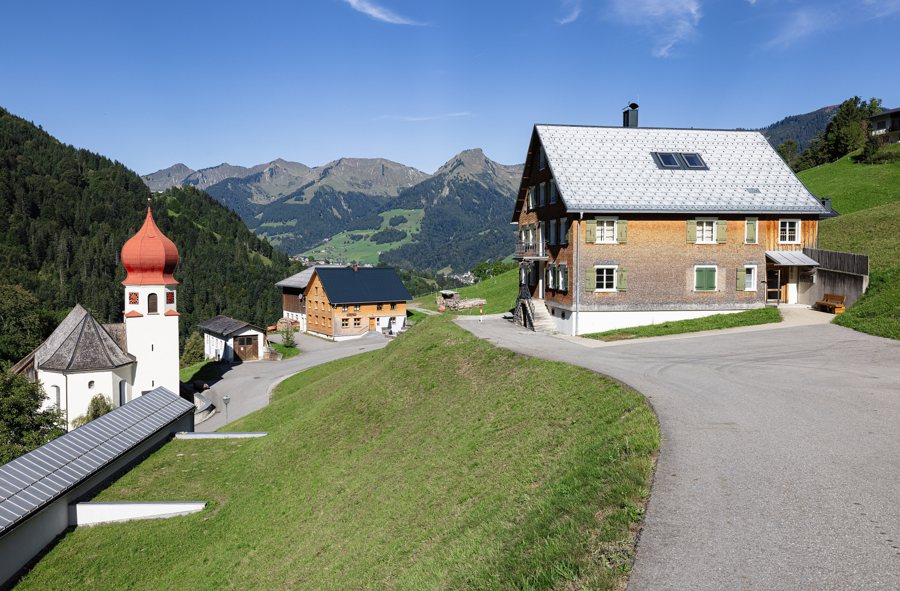 File:Raggal Marul Kurathaus Kuratienkirche.jpg
Photo: Herbert Heim via Wikimedia Commons, CC-BY-SA-4.0
Hiking Trails and Nature
The Marul Forest Adventure Trail invites you to hike, relax, play and enjoy creative activities. There are two route options, measuring 3.4 and 5.6 kilometres. The longer option is 2.2 kilometres longer. This lets you compare the routes by distance; when planning your day, also take into account the other activities along the trail.
The hike along the Marulbach to the Fuchswaldalpe starts at the Marul hiking car park and follows the stream. The car park is the starting point, the stream accompanies you along the way, and the Fuchswaldalpe is the destination. Trail conditions may vary by season; check the current conditions before setting off.
A mountain trail passes through the Faludriga Alpe and enters the Faludriga-Nova nature reserve, which is also a biosphere reserve core zone. The names are not interchangeable when navigating: the Faludriga Alpe is the area the trail passes through; Faludriga-Nova refers to the protected area and core zone that the trail enters. To hike to the core zone, take regional bus L575 to the “Marul Kirche” stop. As bus services may change, check the current timetable before departure.
Churches and Architectural History
St. Catherine’s Kuratie Church in Marul was built around 1670 and restored in 1949 by architect Anton Rhomberg. The choir features stained-glass windows designed by Mila Bjelik-Stöhr in 1948. The building’s history can thus be divided into three key dates: its construction around 1670, the design of the stained glass in 1948 and the restoration in 1949. The two more recent dates are close together, but relate to different aspects of the church: its artistic design and its structural restoration.
Different details take centre stage at the Hubertus Chapel. It was built in 1963 in the Engel parcel by particularly active members of the Catholic Rural Youth (KLJ) at the time. Along the Forest Adventure Trail, it stands beside a reconstructed lime kiln. This offers two points of reference for understanding its cultural history: its origins in the work of the KLJ at the time in the Engel parcel, and its location beside the lime kiln along the trail. Unlike the Kuratie Church, the chapel’s construction date of 1963 is the central point here, while the church’s timeline is shaped by its construction, stained glass and restoration.
Seasonal Information
The Marul organic dairy can also be included in your plans according to the season: during the winter months, it is open every morning; in the summer months, sales take place at the Käsehüsli by the Marul hiking car park. The information distinguishes between the dairy’s winter opening hours and the summer sales location. If you would like to include a visit in your day’s plans, check the seasonal details before travelling.
For an overview of the wider area: Raggal.

