
Biberwier – History, Trails and Nature Destinations
Accommodation in Biberwier
Biberwier offers several different starting points for planning your trip: historic buildings and trails, mining history, and nature and leisure destinations. When choosing accommodation, you can consider whether local history, a themed trail or a longer tour should be the focus of your stay. The local destinations vary in theme and described route, so you can choose those that best match your interests.
Local History and Historic Trails
The Rochus Chapel on the Geißel was Biberwier’s first place of worship. It was built in 1611 and consecrated on August 15, 1625. The dates mark two different stages in its history: its construction and its later consecration. As a historic landmark, the chapel connects local history with a specific building.
Mining is also part of Biberwier’s history. Silver, lead and zinc have been mined at Schachtkopf and Wampater Schrofen since the 15th century. Thus, two named mining sites and three extracted metals are part of the area’s history. Alongside the story of the first place of worship, mining offers another perspective on how Biberwier was shaped over time.
Biberwier lies on the historic Via Claudia Augusta and was already a way station in Roman times. This connection adds the importance of the location on a historic transport route to the local history. The Biberpfad Discovery Trail also takes the Via Claudia as its theme.
Trails Through Biberwier and to the Lakes
The Biberpfad begins at the village park and leads around and through Biberwier. The village’s history comes to life at ten stations. Mining, water, energy and the Via Claudia are the themes explored along the discovery trail. This means the trail focuses not only on the route itself, but also on presenting local history and its different themes. The starting point and route help with planning, while the stations give the trail its local and historical focus.
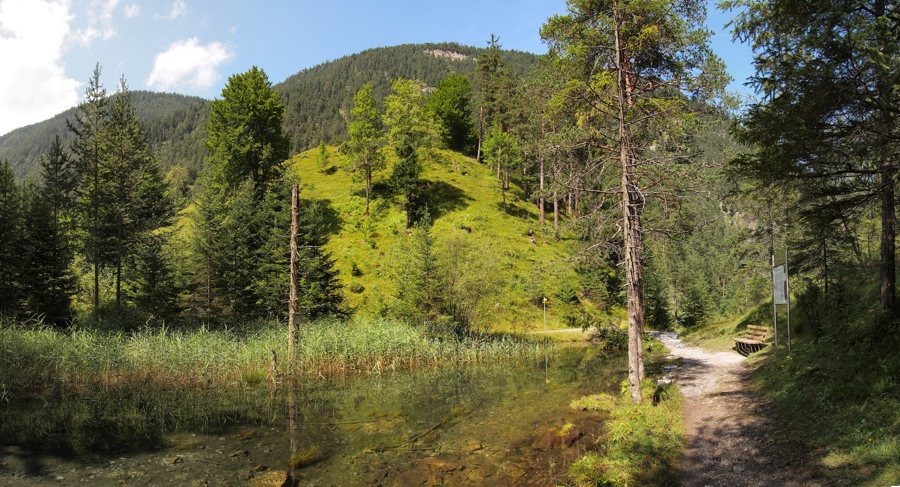
The long Biberwier Three Lakes hike offers a different kind of tour. It leads to the Loisach springs, Mittersee and Blindsee, then heads back towards Biberwier via Weißensee and the Pfarrer-Fink-Steig. The named lakes and return route help you understand the route through its stops. If you prefer to choose destinations based on specific natural places rather than historical themes, this tour offers a distinct focus.
The Loisach springs near Biberwier mark the source of one of the region’s best-known rivers. A cycle path also follows the Loisach from Biberwier to the Bavarian Alpine Foreland. Alongside the discovery trail and the long hike, there is also a cycle path with a destination beyond Biberwier. Check local conditions before setting off on a bike ride.
Summer Toboggan Run and Seasonal Planning
The Biberwier summer toboggan run is 1.3 kilometres long and has 40 bends and a tunnel. It starts at the Marienbergbahn middle station, at an altitude of 1,180 metres, and leads to the valley station. These specific details distinguish the leisure attraction from the hiking and cycling routes: the length, bends and tunnel define the ride, while the hiking route is described by its lakes and the cycle path by its destination.
The summer toboggan run is a seasonal attraction. Check operating conditions before your visit. When planning your stay, you can compare the different options: the chapel, mining and Via Claudia for local history; the Biberpfad for themed stations; the Three Lakes hike for named nature destinations; and the Loisach cycle path for a route to the Bavarian Alpine Foreland. This makes it easier to choose activities that suit the interests of your travel group.
Discover more destinations: Ehrwald, Pinswang, Reutte, Jungholz, Elmen, Elbigenalp, Häselgehr, Steeg.
Go to the main travel overview: Reutte District.

