
Slope Rescue and Ski Patrols: Their Role in Accidents
In the event of an accident on the ski slope, following a clear sequence matters: check that you are safe, make the scene visible, warn approaching skiers and contact professional help. The responsibilities of slope rescue teams, ski patrols and mountain rescue services may be organized differently depending on the ski area. It is therefore important for visitors to know what information to provide in an emergency and where to find local guidance.
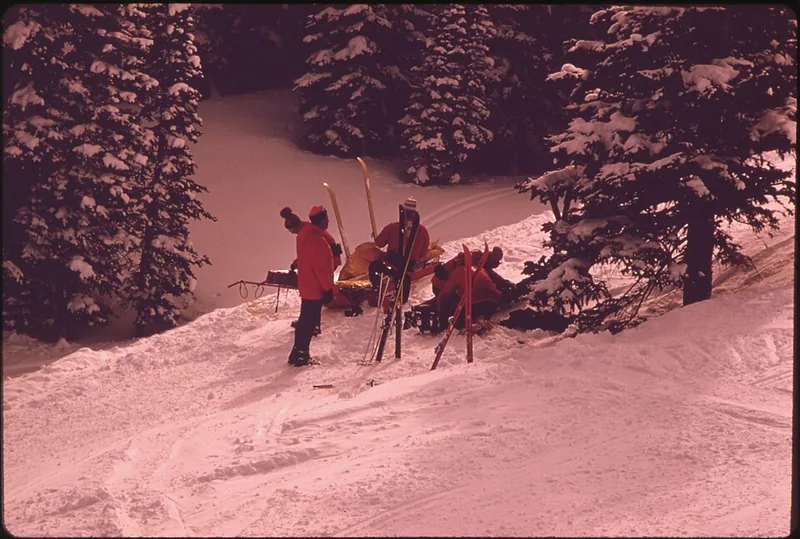 Skiwacht transportiert einen verletzten Skifahrer auf einer verschneiten Piste.
Photo: Ron Hoffman / U.S. National Archives
Skiwacht transportiert einen verletzten Skifahrer auf einer verschneiten Piste.
Photo: Ron Hoffman / U.S. National Archives
Key facts about slope rescue and ski patrols
- Secure the accident scene without putting rescuers or other skiers at additional risk.
- The location, slope, lift, direction of travel and visible landmarks make it easier for rescuers to reach you.
- Follow the local emergency number and the ski area's instructions rather than relying on general assumptions.
- Provide first aid only within the limits of your knowledge and abilities.
- Off-piste areas require additional training and emergency planning.
The first few minutes after an accident
After a fall, first check whether your own position is safe. If possible, place skis or a snowboard across the slope above the accident scene, taking care not to endanger anyone. Helpers should position themselves so approaching skiers can see what has happened and steer clear. One person should stay with the injured person while another gets help or informs staff at a nearby lift station.
Unconsciousness, heavy bleeding, breathing problems, a suspected spinal injury or severe pain are urgent warning signs. Do not move the injured person unnecessarily. Monitor their condition and give rescuers a brief, factual description. If you cannot help, stay at a safe distance if possible and direct the arriving rescue team to the scene.
Emergency calls and location
Clear location details are essential when calling for help. Give the name of the ski area, the slope name or number, a nearby lift or summit station, your altitude or recognizable landmarks, and the number and condition of the injured people. If you are unsure of your location, photos, a map app or information about which lift you took can help. The Europe-wide emergency number 112 can be reached in many situations; make sure you also know the local mountain rescue and ski-area contact procedures.
Responsibility may lie with the ski area, a regional mountain rescue service or other emergency services. Professional mountain rescue organizations work with different control centers and response procedures depending on the region. This does not mean they are responsible for every destination. Before your first day on the slopes, check the ski area's guidance, the location of emergency call points and the local emergency number.
Ski patrols and mountain rescue
A ski patrol or slope rescue team usually operates in the marked ski area and can reach accident scenes, provide assistance and coordinate transport. Depending on the region, mountain rescue services respond to incidents in difficult or uncontrolled terrain. Names, equipment and procedures vary. The page on slope safety and conduct explains how consideration for others and good skiing habits can help prevent accidents.
Helpers should follow barriers and instructions. Searching in closed areas, opening lift doors on your own or entering avalanche terrain can make the situation worse. Even after initial treatment, it is important to follow the rescue team's instructions and have personal details ready for further care.
Prevention and preparation
A charged phone, a brief note with your accommodation and contact details, and knowing how to read the piste map are simple ways to prepare. Groups should agree on a meeting point and stay closer together in poor visibility. For trips off-piste, additional training, safety equipment, up-to-date avalanche information and realistic route planning are essential. If you are unsure, stay in the controlled area or choose a qualified guide.
When you arrive, take a moment to check the emergency information at the ticket office, lift station or accommodation. That way, you will not have to look for it in an emergency. Children and older companions should know whom to contact if the group gets separated.
FAQ: Slope rescue and ski patrols
What should I do first? Check that you are safe, make the accident scene visible and warn approaching skiers.
What information does the emergency service need? The ski area, slope or lift, precise location, number of people affected and injuries you have observed.
Can I move an injured person? Only if there is immediate danger or moving them is essential to provide help. Otherwise, wait for the rescue team.
Are ski patrols organized the same way everywhere? No. Responsibilities, phone numbers and procedures vary by ski area and region.
What applies off-piste? Additional knowledge, equipment and planning are needed, along with an up-to-date assessment of local hazards.
