
Plungė: Park and Cultural History
Accommodation in Plungė
Plungė offers tangible points of interest for a trip that brings together parkland and cultural history. In the park of the Plungė estate, water features and old trees meet the palace of Mykolas Oginskis; in the town, a Neo-Romanesque church and an unusual clock tower, among other landmarks, shape the historic townscape. When looking for accommodation in Plungė, you can consider whether you would like to focus your stay primarily on the landscape, architecture, or cultural heritage.
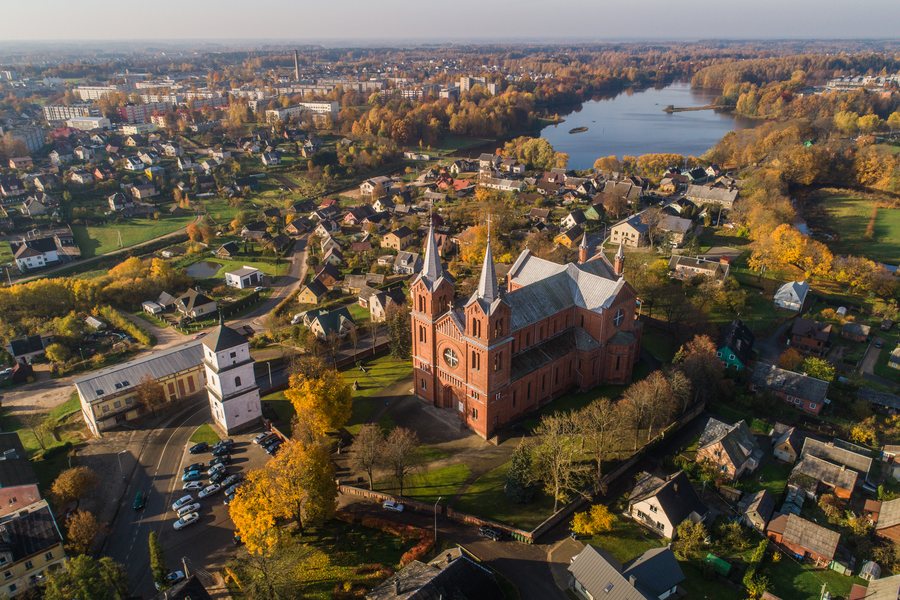 Plungė St John the Baptist church building complex and Lourdes replica with a sculpture of the Holy Virgin Mary 34-P
Photo: Žemaitijos kelias via Source, CC BY-SA 4.0
Park route, ponds, and palace
The visitor route through Plungė Park begins at the park’s main entrance, near the Plungė District Tourist Information Centre. Along the way, you can enjoy views of cascading ponds, old trees and shrubs, and the Neo-Renaissance palace visible through the trees. The park is therefore defined not only by its ensemble of buildings but also by its landscaped waterscape.
At the order of Duke M. Oginskis, seven cascading ponds were created in the park. Stone bridges or sluices connect the ponds; the Babrungas River also flows through the park. The Perkūnas Oak stands in the central part of the park, near the Oginskis Palace. It was declared a natural monument in 1960. These details give the park landscape its own points of reference: the water features, river, old trees, and palace can each be considered part of a visit.
Oginskis traditions and Čiurlionis
The Žemaičiai Art Museum is housed in the palace of Mykolas Oginskis. It preserves and fosters the traditions of Mykolas Oginskis’s estate. Guided tours in English or Russian are available for groups of up to 25 people. The monument to Mikalojus Konstantinas Čiurlionis stands in the park beside the palace and symbolizes the connection between the two figures.
Čiurlionis’s ties to Plungė also give the cultural heritage a personal focus. M. K. Čiurlionis and Sof. Čiurlionienė-Kymantaitė lived in the town’s old rectory in 1909. From 1889 to 1892, Čiurlionis studied at the orchestra school at M. M. Oginskis’s estate in Plungė; he also played the flute in the orchestra. The museum, monument, rectory, and musical history thus represent different aspects of cultural memory.
Church and historic buildings
The Church of St. John the Baptist is considered the main attraction of Plungė’s Old Town. The present stone church was built between 1902 and 1933. Its design was by engineer Steponas Stulginskis, who revised Karl Strandman’s original design. The church is Neo-Romanesque in style, has the ground plan of a Latin cross, and features two towers. The bell tower is an integral part of the church complex and was built by Count P. Zubov in 1850.
Another religious landmark is the stone Catholic Chapel of St. John the Baptist in the old cemetery. It is also known as the All Saints Chapel or the Zubov Chapel and was built in 1858 in the style of Romantic Classicism. The restored Lourdes Grotto of Plungė, with a copy of the statue of the Virgin Mary, was solemnly consecrated on October 20, 1990. The dates and names help distinguish the different historic sites.
Plungė’s clock tower combines distinctive architecture with unusual details: it is twelve metres high, has a clock with just one hand, and a bell that rings on the hour. As the town’s oldest red-brick building, it resembles a miniature version of the Palazzo Vecchio in Florence. After restoration and reconstruction work in 2012, the Plungė Clock Tower Library moved into the castle.
Places of remembrance in the town
More recent history is also present in the townscape. The Freedom Monument was erected in 1928 to commemorate a decade of Lithuanian independence, taken down after the Second World War, and rebuilt in 1992. This gives you several themes to consider when planning your trip: the park and palace, art and music, sacred architecture, or the memory of Lithuania’s independence. This overview can help you get a sense of Plungė as a travel destination before choosing accommodation for your stay.
For the broader travel overview: Telšiai District.

