
Campobasso: Accommodation Among Misteri, Museums and History
Accommodation in Campobasso
On the Sunday of Corpus Christi, the Misteri are paraded through the streets of Campobasso on 13 processional structures carried on the shoulders of bearers. The sculptor Paolo Saverio Di Zinno designed and created these structures in the mid-18th century.
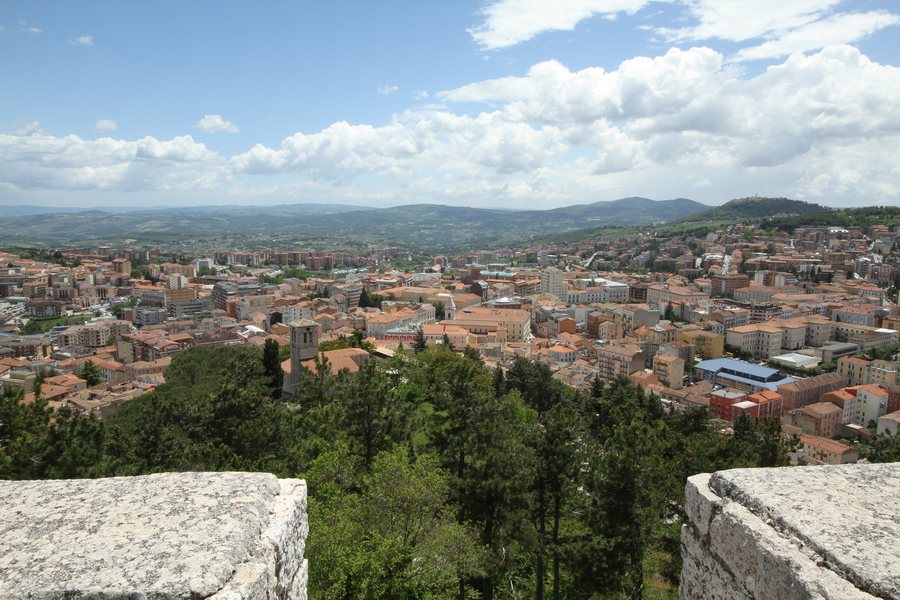 File:Old Town, 86100 Campobasso, Italy - panoramio - trolvag (9).jpg
Photo: trolvag via Wikimedia Commons, CC BY-SA 3.0
Culture
The Museo dei Misteri displays the mechanical “Ingegni” created by Paolo Saverio di Zinno. In the main room, the Sala degli Ingegni “Cosmo Teberino”, visitors can view thirteen “bare” structures with their structural and artistic features. The Museo dei Misteri also has two exhibition halls and a screening room.
The Museo Archeologico Nazionale was founded in 1881 and has been housed and open to visitors in the Palazzo Mazzarotta since 1995. Its collection ranges from prehistory to the Middle Ages, with a particular focus on Samnite finds. The museum houses archaeological materials from, among other places, Campomarino, Guglionesi, Larino, Sepino, Campochiaro and Castello Monforte.
The Convitto Nazionale Mario Pagano also preserves notable features: the Aula Magna has paintings by Romeo Musa, while an oratory is decorated with three large frescoes by Amedeo Trivisonno. In 1572, the Chiesa di Sant’Antonio Abate was converted by the Congrega delle Maestranze from an oratory located outside the city walls into a church. It preserves works by Francesco Guarino da Solofra, Scipione Cecere, Paolo Saverio Di Zinno, Amedeo Trivisonno and Leo Paglione.
The Chiesa di San Giorgio, built in the 14th century, is decorated with frescoes depicting the Church Fathers, Evangelists and scenes from Genesis. The Teatro Savoia was built between 1923 and 1925. Its entrance area, foyer and ceiling above the auditorium are decorated with frescoes by Arnaldo De Lisio from 1925.
An open-air museum for street art has been established in the San Giovanni dei Gelsi district. A street-art trail dedicated to the traditional Misteri festival also runs there. Another religious tradition is associated with the Santuario di Santa Maria del Monte: the particularly venerated statue of the Virgin Mary is carried in procession every year on 31 May.
Nature
Villa De Capoa combines the features of a botanical garden and an urban villa. Its park is home to, among other trees, tall giant sequoias, majestic cedars of Lebanon, cypresses, Norway spruces and lime trees. The garden of the Convitto Nazionale Mario Pagano was laid out at the end of the 19th century and is home to rare species such as the giant sequoia, Ginkgo biloba and the cedar of Lebanon.
Parco Eduardo De Filippo is the most important green space in the San Giovanni district and features diverse planting with numerous tree species. The park includes a play area, sports facilities and works of contemporary art. In summer, it hosts the Festival Nazionale del Teatro Popolare e della Tradizione.
Getting Around and Getting There
Below Castello Monforte, you can walk through Campobasso along narrow, rustic hillside roads and stairways. Campobasso railway station has a bus stop, bicycle parking, cycle paths, parking for cars and motorcycles, and charging stations for electric vehicles. The station also provides an assistance service for people with disabilities or reduced mobility and has three tracks for passenger services.
Local Flavour
L’Abatina is a particularly spicy De.Co. product. After being filled, the sausage is placed under a press, which gives it a flat shape when served as well.
When viewing accommodation or comparing several offers for Campobasso, check the exact location, accommodation type and intended occupancy on the respective offer pages. Included services, individual price components, and booking and cancellation conditions may likewise be presented differently. These points can be compared directly before booking. Then open the appropriate offer page to check the terms and conditions shown there.
Further destinations: San Massimo, Isernia.
For the higher-level travel overview: Molise.

