
Völs between Culture and Nature
Accommodation in Völs
Völs combines historic churches and local culture with places for leisure and nature. Each theme has its own focus: some tell of centuries of church history, while others are shaped by pools, a terraced site or a wetland habitat.
Museum and Churches with Their Own History
The Thurnfels Museum is housed in the historic municipal building, the former Thurnfels residence, also known as the Tower of Völs. The museum is therefore connected to a building that is itself part of the town’s history. The Church of St. Blaise, in turn, is now a landmark of Völs. It was first mentioned in 1286 and was already a popular pilgrimage site in the 15th century. A Way of the Cross beginning near the village square leads to the church.
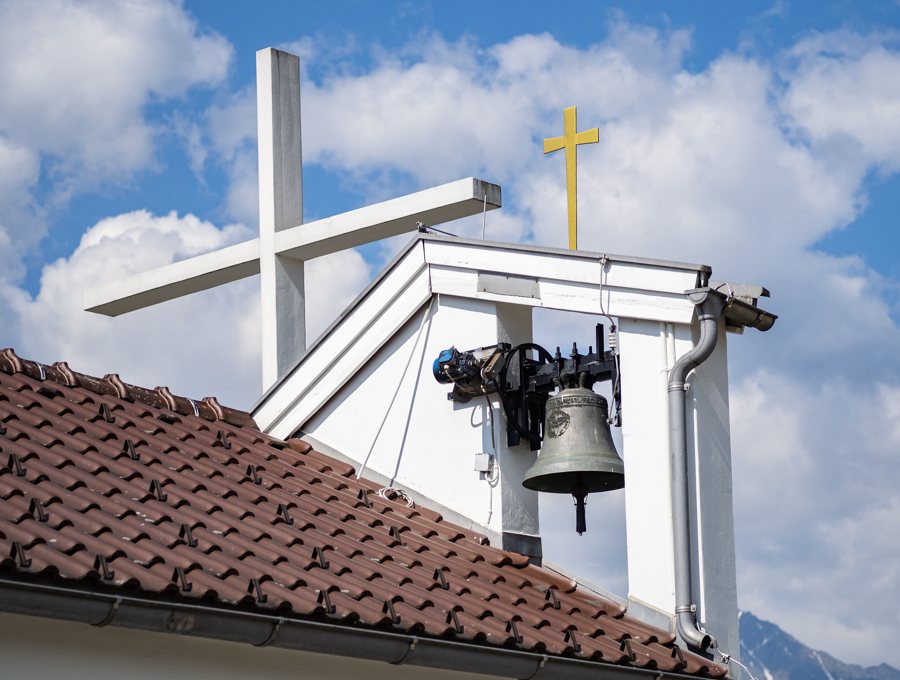
The other churches also have their own historical and artistic highlights. Fragments of Gothic frescoes depicting the Last Judgment have been preserved in the Old Parish Church. The Emmaus Church was built in 1966/67 as a new church center for the Völs community, based on plans by architect Josef Lackner. Its furnishings include the large Nativity scene in an Oriental style: the local association of Nativity scene enthusiasts built it in 1997, over more than 1,000 hours of work. As a seasonal feature, it represents a different aspect of local culture from the frescoes and historic churches.
The Chapel of St. John of Nepomuk contains an artistically valuable figure of the saint in a pointed-arch niche. It is believed to date from the first half of the 19th century. The Völs Bacchus is currently considered the only surviving piece of its kind in Tyrol. Another link between the town and its history is the crucifixion group at the plague cemetery: it lies north of the old village center, near the railway on Kranebitter Straße, is dated to the mid-17th century and commemorates the plague of 1637, which left Völs almost completely depopulated.
Leisure by the Water and Nature at the Pond
The “Völser Badl” outdoor swimming pool is located below Blasiusberg on a 12,000 m² terraced slope. Facilities include a sports pool suitable for competitions, an adjacent teaching pool and a children’s area with a generously designed play stream. The swimming pool café has a viewing terrace with panoramic views. This combination of different pools and terraces clearly distinguishes the Badl, in its description, from a simple body of water in the landscape.
The Völs pond is a different kind of place: this 3,700 m² recreational area has a maximum depth of 1.3 meters and is also a wetland habitat. Protected animal species found there include the common toad, common frog and European tree frog, as well as the European green toad; there are also 11 dragonfly species. When planning your trip, it is worth keeping these two themes distinct: the Badl is described as an outdoor swimming pool with specific pools, while the pond is defined by its recreational landscape and habitat.
Walking Surroundings and Seasonal Features
Thanks to its central location, Völs is a suitable starting point for numerous walks in the surrounding area and in the nearby Karwendel Mountains. The walking routes add another way to enjoy your stay, complementing the town’s history and the leisure spots described here. In winter, part of the artificial turf pitch at the Völs sports ground is also artificially iced. This seasonal feature sits alongside very different, year-round topics such as churches, frescoes and the wetland habitat.
Whether you would like to focus more on culture, water and nature, or a mixture of these on your trip, the places mentioned offer different starting points for planning. Historical dates, specific facilities and descriptions of nature help you compare the highlights without combining them into a single excursion destination.
Discover more destinations: Hatting, Kematen In Tirol, Sistrans, Gries Im Sellrain, Axams, Gschnitz, Aldrans, Volderau
See the regional travel overview: Innsbruck-Land.

