
Ice Sailing on a Winter Holiday: Equipment, Rules and Planning
Ice sailing can add an athletic dimension to a winter holiday, but it calls for a realistic assessment of your abilities, the conditions and what is on offer. If you are trying the activity for the first time, plan a short session with instruction rather than an ambitious program without preparation.
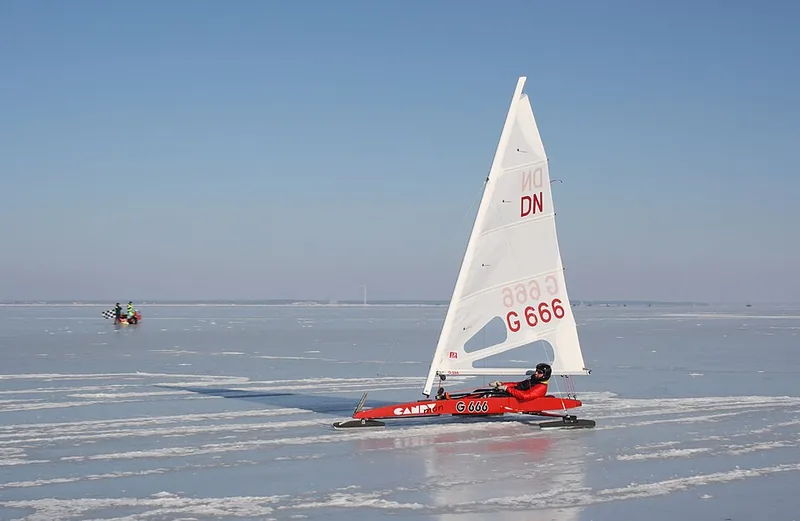 Eissegler mit Segel auf einer winterlichen Eisfläche.
Photo: Raul Kern
Understanding ice sailing
Ice sailing takes place on a sufficiently strong, officially approved ice surface and uses specially built ice yachts or sail-powered sleds. The vehicles glide on runners and respond directly to wind direction, gusts and the condition of the ice. This makes the sport exciting, but also demanding. A frozen lake is not automatically suitable for ice sailing; official approval, ice checks and local restrictions are decisive.
Regatta sailing has different classes, each with its own dimensions and rules. For travelers, this distinction is most relevant when a club offers an introductory outing or event. Beginners should not venture onto an unfamiliar ice surface on their own. They need instruction, a suitable vehicle and clear information about the starting area, return, wind limits and emergency assistance.
Choosing and preparing
Before booking or traveling, check the specific facility: Is there a suitable area, a course, rental equipment or supervised instruction? Opening hours, admission, minimum age, reservations, local rules and current operating status are set by the respective operator. General information from an association can help put things in context, but does not replace local guidance.
For families and groups, the program should accommodate different skill levels. A shared meeting point away from the activity area helps avoid unnecessary searching. If you combine several winter activities, plan for rest and dry changes of clothes. Water, a small snack and a charged phone are useful for longer outings.
Equipment suited to your ability
Equipment must suit the sport, the area and your experience. Before setting off, check rental equipment for size, fit, fastenings and visible damage. Warm, flexible clothing in several layers offers better protection than one very heavy layer. Gloves, dry socks and a windproof outer layer belong in your bag for outdoor activities. Protective gear such as a helmet, back, knee or wrist protection may be advisable or required, depending on the discipline and your ability.
Weather, exertion and safety
Snow, ice, wind, visibility and temperature can change over the course of a day. Before setting off, check the facility’s latest notices and, where relevant, weather or avalanche information. End the session if visibility is poor, you hear unusual noises, equipment is damaged or your concentration is waning. Beginners should choose clearly visible, approved areas and increase difficulty and duration gradually. Children need clear rules, short sessions and adult supervision.
Be considerate on shared areas: follow the direction of travel, keep your distance, and observe marked routes and closures. If you fall or notice an injury, move safely out of the way and get help. Away from supervised facilities, only people with appropriate experience and equipment, and a current assessment of the hazards, should venture out.
Warm, windproof clothing and a well-fitting helmet are especially important for ice sailing. Depending on the boat and local requirements, safety equipment, ice picks or other protective gear may also be needed. Before setting off, check the runners, sail, steering and fastenings. Do not launch during a thaw, or if there are cracks, water on the ice, fog or strong gusts.
Expert information and local checks
The International DN Ice Yacht Racing Association provides information about the DN class and its regatta context. Iceboating International offers expert information about ice sailing. Only local authorities, clubs or operators can provide specific approval for the ice and local safety instructions.
Special responsibility on natural areas
Ice can lose its load-bearing capacity within a short time. Even an area that was previously approved must be reassessed after a thaw, rain or strong winds. Do not cross areas with water, snow cover or cracks. Ice sailors should tell a responsible person when they set off and when they expect to return, and stay within designated zones. Without local approval, keep the vehicle on shore, even if the ice looks unbroken.
Frequently asked questions about ice sailing
Can you try ice sailing on the spur of the moment?
Only if a local facility is open and staff have approved the ice and conditions. Trying it on your own on unfamiliar lakes is not advisable.
What role does the wind play?
Wind speed and gusts affect speed and control. The facility or an experienced operator sets the permitted limits.
Is warm winter clothing enough?
It is necessary, but does not replace proper safety equipment and instruction. The organizer’s requirements are what matter.
